Kanban is a method of reducing costs and improving efficiency in manufacturing. These principles minimize downtime and reduce inefficiencies. They result in faster manufacturing, delivery and customer service. This allows for continuous improvement.
Kanban is a method to manage and organize work flow. It allows manufacturers and teams to monitor and track their work and increase productivity. Kanban involves the creation of a visual representation of the steps involved in a particular process and the identification and minimization or inefficiencies.
You can either use a software program or manually to implement the kanban method. Software can be used to help teams determine what should be done and who should. Employees can also adapt to feedback and make improvements in their work processes using the kanban method. It's also useful for brainstorming.
Kanban boards, which are boards that show a process, are one of the most well-known Kanban examples in manufacturing. The board lists the steps in the process, in priority order. For example, the first task is to contact a supplier. The second task involves ordering the materials required to complete the project. The third task involves manufacturing. The fourth task will be to test and deliver the final product.
Kanban allows teams to visualize their process and make small adjustments as needed. Kanban boards are also useful for improving communication between teams as well as identifying and addressing any bottlenecks.
Kanban is also intended to reduce waste, as well as encourage information sharing. This is especially useful when the company is trying to implement lean principles. Waste can come in many forms and can accumulate over the course a manufacturing process. The manufacturer can add value to every stage of the manufacturing process by removing waste. The kanban system is also useful in managing inventory. It can help to control inventory overstocking.
Kanban can also be used to visualise the process and reduce costs. It can improve the efficiency of the process and lead to a decrease in the number items necessary to complete a task. It improves communication and minimizes downtime. The kanban system is a good example of how technology can help with a difficult task.
Kanban is also useful for brainstorming and productivity. It can connect companies to suppliers and improve communication. It can also be used to improve quality and streamline production.
One of the most well-known Kanban methods in manufacturing is the board. Tasks are organized according to priority and time needed to complete them. The board also displays the steps involved in a process, such as design, manufacturing, and testing.
FAQ
How can manufacturing excess production be decreased?
Better inventory management is key to reducing excess production. This would reduce the amount of time spent on unnecessary activities such as purchasing, storing, and maintaining excess stock. This will allow us to free up resources for more productive tasks.
One way to do this is to adopt a Kanban system. A Kanban board, a visual display to show the progress of work, is called a Kanban board. Kanban systems allow work items to move through different states until they reach their final destination. Each state represents a different priority.
As an example, if work is progressing from one stage of the process to another, then the current task is complete and can be transferred to the next. But if a task remains in the beginning stages it will stay that way until it reaches its end.
This helps to keep work moving forward while ensuring that no work is left behind. With a Kanban board, managers can see exactly how much work is being done at any given moment. This information allows managers to adjust their workflow based off real-time data.
Lean manufacturing is another option to control inventory levels. Lean manufacturing focuses on eliminating waste throughout the entire production chain. Anything that does not contribute to the product's value is considered waste. These are some of the most common types.
-
Overproduction
-
Inventory
-
Packaging that is not necessary
-
Materials in excess
Manufacturers can increase efficiency and decrease costs by implementing these ideas.
Do we need to know about Manufacturing Processes before learning about Logistics?
No. No. However, knowing about manufacturing processes will definitely give you a better understanding of how logistics works.
What are the responsibilities for a manufacturing manager
Manufacturing managers must ensure that manufacturing processes are efficient, effective, and cost-effective. They should be aware of any issues within the company and respond accordingly.
They should also be able and comfortable communicating with other departments like sales and marketing.
They should also be knowledgeable about the latest trends in the industry so they can use this information for productivity and efficiency improvements.
What is the distinction between Production Planning or Scheduling?
Production Planning (PP), or production planning, is the process by which you determine what products are needed at any given time. This can be done by forecasting demand and identifying production capabilities.
Scheduling involves the assignment of dates and times to tasks in order to complete them within the timeframe.
What can I do to learn more about manufacturing?
Practical experience is the best way of learning about manufacturing. You can read books, or watch instructional videos if you don't have the opportunity to do so.
What are the essential elements of running a logistics firm?
To be a successful businessman in logistics, you will need many skills and knowledge. Good communication skills are essential to effectively communicate with your suppliers and clients. It is important to be able to analyse data and draw conclusions. You must be able and able to handle stress situations and work under pressure. In order to innovate and create new ways to improve efficiency, creativity is essential. Strong leadership qualities are essential to motivate your team and help them achieve their organizational goals.
It is also important to be efficient and well organized in order meet deadlines.
Statistics
- (2:04) MTO is a production technique wherein products are customized according to customer specifications, and production only starts after an order is received. (oracle.com)
- You can multiply the result by 100 to get the total percent of monthly overhead. (investopedia.com)
- In the United States, for example, manufacturing makes up 15% of the economic output. (twi-global.com)
- According to a Statista study, U.S. businesses spent $1.63 trillion on logistics in 2019, moving goods from origin to end user through various supply chain network segments. (netsuite.com)
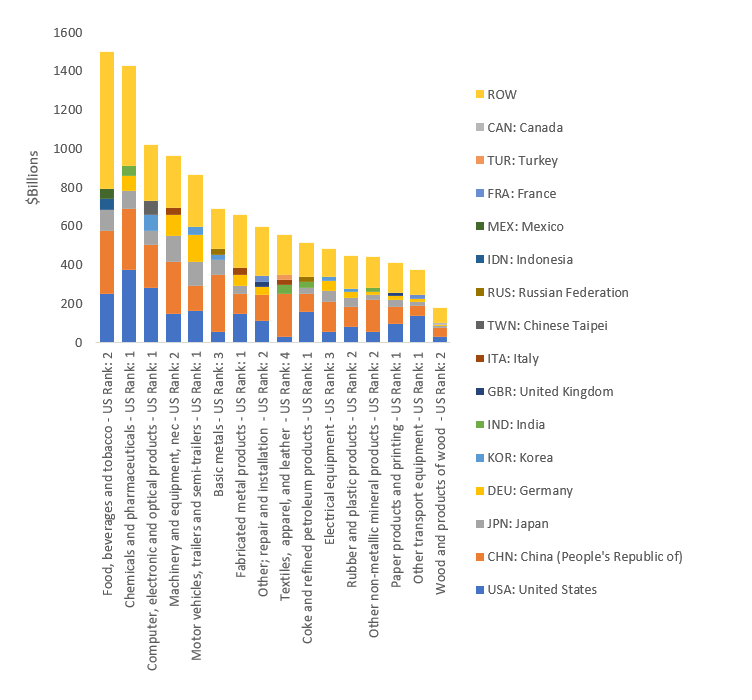
- According to the United Nations Industrial Development Organization (UNIDO), China is the top manufacturer worldwide by 2019 output, producing 28.7% of the total global manufacturing output, followed by the United States, Japan, Germany, and India.[52][53] (en.wikipedia.org)
External Links
How To
Six Sigma: How to Use it in Manufacturing
Six Sigma is "the application statistical process control (SPC), techniques for continuous improvement." Motorola's Quality Improvement Department, Tokyo, Japan, developed it in 1986. Six Sigma's main goal is to improve process quality by standardizing processes and eliminating defects. Since there are no perfect products, or services, this approach has been adopted by many companies over the years. The main goal of Six Sigma is to reduce variation from the mean value of production. This means that you can take a sample from your product and then compare its performance to the average to find out how often the process differs from the norm. If this deviation is too big, you know something needs fixing.
Understanding the dynamics of variability within your business is the first step in Six Sigma. Once you have a good understanding of the basics, you can identify potential sources of variation. You'll also want to determine whether these variations are random or systematic. Random variations are caused by human errors. Systematic variations can be caused by outside factors. These are, for instance, random variations that occur when widgets are made and some fall off the production line. However, if you notice that every time you assemble a widget, it always falls apart at exactly the same place, then that would be a systematic problem.
Once you've identified where the problems lie, you'll want to design solutions to eliminate those problems. That solution might involve changing the way you do things or redesigning the process altogether. To verify that the changes have worked, you need to test them again. If they don’t work, you’ll need to go back and rework the plan.